Why Did My Flood Insurance Premium Increase?
If you've recently renewed your flood insurance policy and noticed a higher premium, you're probably wondering what's behind the increase. Flood insurance costs can change from year to year, sometimes even when your property hasn't experienced any flooding.
Understanding why your flood insurance premium increased can help you identify potential savings and make more informed decisions about your coverage.
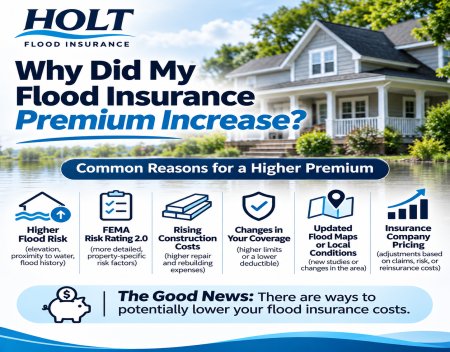
One of the biggest factors affecting flood insurance premiums is your property's risk of flooding.
Insurance providers evaluate several factors when determining your rates, including:
Property elevation: Homes at lower elevations may face greater flooding risks.
Distance from water: Properties near rivers, lakes, and coastlines may be more vulnerable.
Flood frequency: Areas with a history of flooding may face higher premiums.
Building characteristics: Your home's foundation type, construction, and replacement cost can influence pricing.
If updated flood risk assessments indicate that your property is more vulnerable than previously estimated, your insurance premium may increase.
The Federal Emergency Management Agency (FEMA) uses a pricing methodology called Risk Rating 2.0 for policies offered through the National Flood Insurance Program (NFIP).
Rather than relying primarily on flood zone classifications, this system considers more detailed property-specific risk factors.
These include flood frequency, distance to water, elevation, potential flood damage, and building replacement costs.
As a result, some homeowners may experience premium increases even if their official FEMA flood zone hasn't changed.
Additionally, NFIP policies may experience phased premium adjustments as they move toward their full-risk rates, subject to applicable annual increase limits.
The cost of repairing or rebuilding a home can influence flood insurance pricing.
When construction materials, labor, and replacement costs increase, the potential financial impact of flood damage may also rise.
Insurance companies may adjust their pricing models to account for these higher costs.
Even if your home's physical flood risk remains unchanged, increasing rebuilding expenses can contribute to higher premiums.
Sometimes, a premium increase is related to changes in your policy rather than changes in flood risk.
For example, your premium may increase if you:
Increase your building coverage limits.
Add or increase personal property coverage.
Choose a lower deductible.
Make improvements that increase your property's insured value.
Reviewing your policy's declarations page can help you determine whether coverage changes contributed to your higher premium.
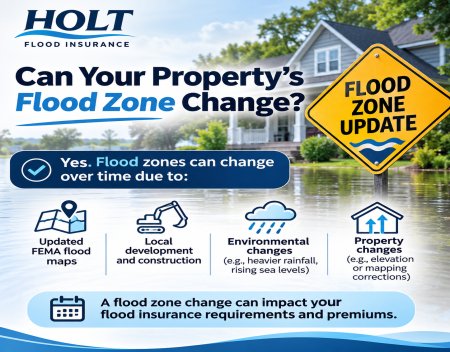
FEMA periodically updates flood maps to reflect new studies and changing flood risks.
Development, drainage modifications, coastal erosion, and other environmental changes can influence how flood risk is assessed.
Although an updated flood zone designation does not automatically determine your NFIP premium under Risk Rating 2.0, new flood risk information may affect insurance pricing or coverage requirements.
Private flood insurance companies may also incorporate updated mapping and risk data into their pricing models.
If you have a private flood insurance policy, your premium may increase because of changes in your insurer's pricing.
Private insurers evaluate their exposure to flood losses and may adjust rates based on factors such as:
Recent flood claims and catastrophic weather events.
Changes in reinsurance costs.
Updated risk modeling.
Rising property repair expenses.
Changes in the insurer's underwriting guidelines.
These adjustments can affect your premium even if you haven't filed a claim.
Fortunately, a premium increase doesn't necessarily mean you're stuck paying more.
Here are several ways to explore potential savings.
Different private flood insurance providers may assess your property's risk differently.
Comparing quotes from multiple insurers can help you find competitive pricing and coverage that meets your needs.
Check whether your current coverage limits and deductible still make sense for your property.
Choosing a higher deductible may reduce your premium, although you'll pay more out of pocket if you experience a covered loss.
Certain property improvements may help reduce flood risk and potentially lower insurance costs.
Depending on your property and insurer, these could include elevating utilities, installing compliant flood openings, or elevating the building.
Incorrect building characteristics or outdated property information could affect your flood insurance premium.
Review your policy details with your insurance provider to ensure the information used to calculate your rate is accurate.
If your flood insurance premium has increased significantly, comparing providers may be worthwhile.
Private flood insurance can sometimes offer competitive rates, flexible coverage options, or higher coverage limits than those available through the NFIP.
However, private policies vary in their exclusions, deductibles, coverage terms, and renewal conditions.
Before switching, make sure your new policy meets any applicable mortgage lender requirements and provides appropriate protection for your property.
A higher flood insurance premium can be frustrating, but understanding what's driving the increase is the first step toward finding a better solution.
At Holt Flood Insurance, we help homeowners and property owners explore flood insurance options and compare coverage to find competitive rates.
Whether your premium recently increased or you're simply looking for a better flood insurance policy, our team is here to help.
Visit HoltFloodInsurance.com today to request a flood insurance quote and explore your options.

I have known Tim for many years and he is a man with great integrity, work ethic and one of the nicest persons I know. Over the years Tim has provided insurance counseling and advice to our company, for myself personally, as well as to our clients. Recently Tim, took time to analyze our flood insurance policy and he was able to make some excellent recommendations. Our flood insurance costs are now less and we have much better coverage. I recommend Tim to anyone without hesitation or reservation.
We contacted Mr. Holt for an estimate via email over the weekend prior to a closing on a property, hoping for a response on the following Monday to take with us with confidence in being insured at the settlement table on a Tuesday. He exceeded our expectations not once but in readily responding to the initial request and then to follow-up questions all during the weekend frenzy that occurs before closing. "Impressive and responsive customer service," for sure!
I have no problem giving you an A1 reference for taking care of the flood policies for me and Diane. I appreciate you working with the mortgage company: the surveyor and our previous agent. The result was a 75% reduction in our flood insurance premiums!

We'll help you:
Lower your current flood insurance premiums
Eliminate excessive & unnecessary coverage
Remove the FEMA from the claims handling process